A community nickname, taken literally
Wolverine peptide is a nickname. People also type it as the wolverine peptide stack, or the wolverine stack peptide, for the same two compounds, BPC-157 and TB-500. The word came out of a community, not a laboratory. For years the sharpest line about the pairing was a seller's own admission that no study had tested it. In 2026 one study finally did, and it found no added benefit from combining the two over either compound alone.
Checked .
Affiliate partner disclosure: our links to Peptara Labs are affiliate-partner links, and this site earns a commission when you buy through them. Peptara Labs is a partner we trust, and it is also the company that published the page we lean on hardest, the one saying no study tested this pairing. Weigh both of those at once, then read on. Our notice follows the FTC endorsement guides.
Wolverine peptide is an informal community name for BPC-157 combined with TB-500.
The name is taken from a fictional character in the comics, and it points at that character, not at any result.
There is no standardised formula behind it, and some sources also fold in CJC-1295 or Ipamorelin.
The evidence base behind those two compounds is described as largely preclinical, and one exploratory rat study in 2026 tested the pair and found no additional benefit over either compound alone, with no human trial of the pair on record.
Everything below this box is the long version of those four lines.
Four cards, one per thing on record about the name. Each names what is on record, says it in plain words, and points to the page that lays it out.
Both live answers traced the word to a fictional character in the comics. A nickname is a naming act, and it carries no finding across with it. What the name proves about a compound is nothing.
Read where a comics reference got attached to two compounds.
Both engines, checked the same day, said there is no standardised formula. Both also said some sources add CJC-1295 or Ipamorelin. Two people using the word can be describing two different sets of compounds.
See why two sources using this name may mean different things.
For years the only useful line came from the seller, which said no study had tested the pairing. In 2026 an exploratory rat study tested the two together and found no added benefit over either compound alone. A study exists now, and it is a null result.
One of the two named compounds carries a certificate identifier and a second-laboratory report. The other is not among the four batches with that second report. One name, two compounds, two different paper trails.
Both live answers on 2026-09-01 said the same thing about the name. It is informal, it came from a community, and it is taken from a fictional character whose healing, in the comics, is the whole reason the word exists. That is the entire origin story we can stand behind, and padding it would mean inventing the rest.
A nickname is a naming act, not a finding. It does not carry a single property of the character across to a compound, and this sentence is here so no reader leaves with that transfer intact. We do not know who first typed it, on what day, or in what room, so we say none of those things.
Naming reference read on: Healthline, "What's the Wolverine Peptide Stack and Is It Safe?"
The two engines agreed on the two core compounds, BPC-157 and TB-500. They also agreed there is no standardised formula. Then they added the wrinkle: some sources fold in CJC-1295 or Ipamorelin under the same word.
Here is the consequence, and it is the actual value of this page. Two writers can use the phrase and mean two different sets of compounds, and a reader moving between them is never told. That is a fact about the word, not about any compound. The two compounds both engines named are also listed in the vendor catalog we disclose, where CJC-1295 with Ipamorelin appears as one combined entry.
The table sets three compounds beside what is separately published about each of them. It is the first of two tables here, this one about the name and the research table further down about the studies, and it is here to show a grouping coming apart, not holding together.
| Compound, as sources write it | In the definition both engines gave on 2026-09-01 | Listed in the vendor catalog checked 2026-09-01 | Certificate record | Second-laboratory endotoxin report | How far this site went |
|---|---|---|---|---|---|
| BPC-157 | Named by both | Listed | Published | One of the four published | Downloaded, file type confirmed |
| TB-500 | Named by both | Listed | Published | Not among the four | Listed on the vendor page, not opened here |
| CJC-1295, with Ipamorelin | Added by some sources, per both | Listed as one combined entry | Published | Not among the four | Listed on the vendor page, not opened here |
The certificate record reads Published on every row for one reason: the certificates page shows two records as Pending, Epithalon and Glutathione, and none of these three compounds is one of those two.
Every row is what is published about one compound on its own. Putting three rows in one table is not a suggestion that anything belongs in one container.
Peptara Labs publishes an article about BPC-157 with TB-500. It says each of the two compounds carries a mechanism literature of its own, and that the pairing itself had never been through a study. That was written before the study below appeared. It was accurate on the day it went up, so we read it as out of date now, not as wrong.
In 2026 one study finally put the two together, in animals. Researchers took rats whose Achilles tendon had been surgically cut and sutured, and split them into four groups of eight: control, BPC-157 alone, TB-500 alone, and the two combined. At four weeks after surgery they measured maximum load to failure, scored the tendon tissue with the Bonar and Movin histology systems, and ran collagen staining and immunostaining.
The direction of the results, and nothing finer than direction. On their own, both compounds were associated with better tendon histology than the control group. TB-500 alone also showed a statistically significant biomechanical advantage, and BPC-157 alone scored numerically better without reaching significance on the total scores. The combined group showed no additional benefit over either compound on its own. The authors call the work exploratory and preliminary, offer a shared-pathway idea they say needs confirmation, and report no human data.
One human record exists, and it is thin. A 2021 retrospective chart review at a single clinic looked back at sixteen patients with knee pain of mixed causes, reached by phone six months to a year later and asked to rate their own pain, with no validated instrument. Twelve had been given BPC-157 alone; four had been given BPC-157 together with thymosin beta-4. Most reported that the pain had eased, eleven of the twelve alone and three of the four combined. The evidence level is what it is: human, retrospective, self-reported, uncontrolled, one clinic. The paper's closing lines about what the peptide can do are the authors' opinion, not a finding of the review.
This is not a gap we are guessing at. A search of the published record on 2026-09-05 returned 71 citable entries across the two compounds. Eight name both. Two are the studies just described. The other six are reviews that discuss each compound on its own and never gave the two together.
We earn a commission from Peptara Labs, and its article is still the page we disclose most loudly. It simply predates the study, which is why the record now leads and the article follows. The fuller write-up sits under the one study that tested the pair.
Sources: the 2026 animal study, the 2021 chart review, and the vendor article on the pairing.
Both engines, on 2026-09-01, described the evidence base behind these compounds as largely preclinical. The word is a location, not a verdict. It marks work that has not been carried through human study, and it is neither a promise that something will work nor a finding that it will not.
As of 2026-09-05 this is no longer a page with no records to show. It names its sources in the evidence table just below, each one opened and checked, and preclinical still marks where most of that work sits, in animal and bench models rather than human trials of the pair. If you want what that word marks, and what it does not, it has a page of its own.
Here the site stops talking about the word and starts naming records. Every row below is a published source on one or both of the two compounds, opened and checked on 2026-09-05. The reviews describe mostly preclinical work and characterise the evidence; the registered trials are listed so the picture is complete, and a registration tells you a study was filed, not what it found.
| Source | Year or status | Type | Compound, as recorded | What it covers | What it reports |
|---|---|---|---|---|---|
| PubMed 40005999 | 2025 | Review | BPC-157 | Pharmaceuticals literature and patent review: BPC-157 in models of tissue injury, inflammatory bowel disease and central nervous system conditions | Not approved for medical use; a temporary WADA listing noted in 2022 |
| PubMed 30915550 | 2019 | Review | BPC-157 | Cell and Tissue Research review: BPC-157 in animal models of musculoskeletal soft tissue injury | Discusses the limits of growth factor therapies |
| PubMed 40756949 | 2025 | Review | BPC-157 | HSS Journal systematic review: BPC-157 in orthopaedic sports medicine, across fractures, tendon, ligament and muscle injuries | No FDA approval, banned in professional sport, and rising use despite that |
| PubMed 41490200 | 2026 | Review | BPC-157, TB-500, GHK-Cu | Journal of the AAOS review: therapeutic peptides in orthopaedics | Describes BPC-157, TB-500 and GHK-Cu through angiogenesis, extracellular matrix remodeling and fibroblast activation, with growth hormone secretagogues treated separately |
| PubMed 41966639 | 2026 | Review | Approved and unapproved peptides | Sports Medicine review: peptides for musculoskeletal injury and performance | Describes a gray market of unapproved compounds outside regulatory oversight |
| PubMed 42578445 | 2026 | Review | BPC-157, thymosin beta-4 | A 2026 summary of peer reviewed data on six emerging peptides, BPC-157 and thymosin beta-4 among them | States an absence of efficacy or safety data for many emerging peptides |
| PubMed 42635865 | 2026 | Review | BPC-157, thymosin beta-4, TB-500, GHK-Cu | Current Pain and Headache Reports narrative review: peptides in chronic pain | Proposed mechanisms, preclinical and clinical evidence, safety and regulatory status |
| PubMed 41476424 | 2026 | Review | Peptides in orthopaedics | American Journal of Sports Medicine primer: peptide therapy in orthopaedics and sports medicine, written for surgeons | Sets out the current evidence behind peptide therapy |
| PubMed 42021992 | 2026 | Review | Peptides in aging | Frontiers in Aging narrative review: peptides in aging | Searches of PubMed, Scopus, FDA and WADA databases to January 2026 |
| PubMed 17495252 | 2007 | Review | Thymosin beta-4, full peptide | Annals of the New York Academy of Sciences review: coronary vessel development and neovascularization in animal models | Covers the full peptide, not the TB-500 fragment |
| NCT07437547 | Recruiting, phase 2 | Registered trial | BPC-157 | Acute hamstring muscle strain | A registration, which reports no outcome |
| NCT07803250 | Not yet recruiting, phase 1 | Registered trial | BPC-157 | Following rotator cuff surgery | A registration, which reports no outcome |
| NCT02637284 | Unknown status, phase 1 | Registered trial | BPC-157 (PCO-02) | Safety and pharmacokinetics | A registration, which reports no outcome |
| NCT07487363 | Recruiting, phase 1 and 2 | Registered trial | TB-500, the 17 to 23 fragment of thymosin beta-4 | Cardiovascular biomarkers in stable ASCVD | A registration, which reports no outcome |
| NCT04555824 | Completed, phase 1a | Registered trial | Thymosin beta-4, full peptide | Safety in volunteers | A registration, which reports no outcome |
| NCT05984134 | Completed, phase 2 | Registered trial | Thymosin beta-4, full peptide | Acute myocardial infarction | A registration, which reports no outcome |
| NCT00311766 | Terminated, phase 2 | Registered trial | Thymosin beta-4, full peptide | Wound outcomes in epidermolysis bullosa | A registration, which reports no outcome |
| NCT02974907 | Completed, phase 3 | Registered trial | RGN-259, a thymosin beta-4 eye drop | Dry eye syndrome | A registration, which reports no outcome |
TB-500 is a fragment of thymosin beta-4. A trial of the full peptide is not a trial of TB-500, and the rows above keep the two labelled apart.
Here is the honest ledger. What exists is a set of reviews of mostly preclinical work, one exploratory rat study that tested the pair, one small retrospective human chart review, and a handful of registered trials that have reported nothing yet. That is the whole of it, and no line here turns any of it into advice for a person.
The one study of the pair measured its outcomes at four weeks after surgery. No human study of the pair reports any timeline at all, because the single human record is a look back at charts rather than a schedule. This site does not restate trial schedules, and on the pairing there is none to restate.
There is no before and after on record for the pair. No photo set, no paired scan. What the studies measured instead was narrower and duller: load to failure, histology scores, collagen organisation. Those are bench and tissue readouts, not a picture of a person.
This page prints no price. The vendor page does, and this site earns a commission if you buy through our links, which is disclosed at the top and the bottom of every page. What the name costs is a number we point at, never one we set or reprint.
The first named compound has a paper trail, and it is worth reading before the nickname borrows its credibility. Batch testing is credited to Titreon Analytical, which the live page calls a third-party laboratory whose quality system is aligned to ISO/IEC 17025:2017, not itself accredited.
A certificate on that page confirms seven things:
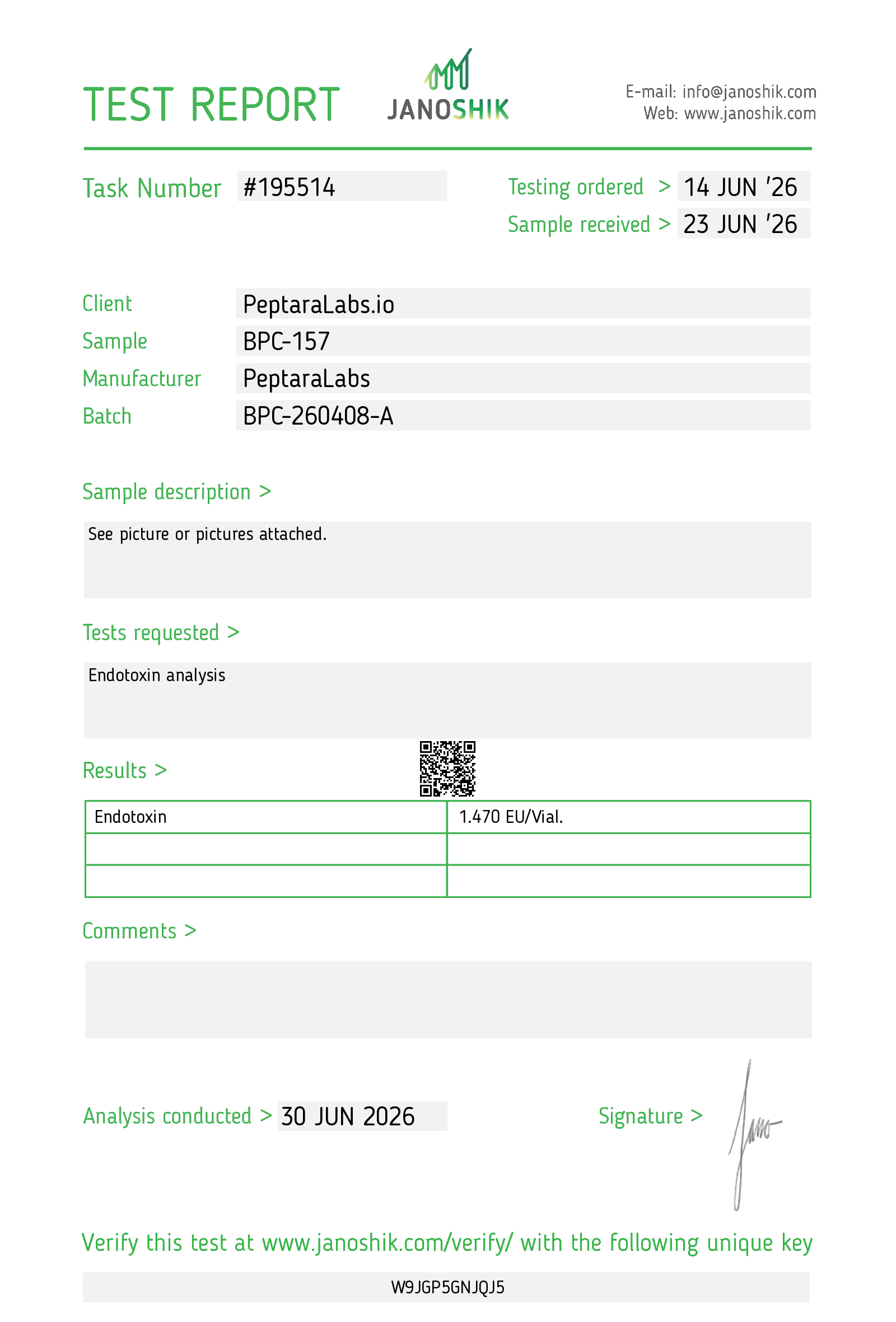
The vendor identifies one certificate by name: COA-2026-8642, a four-page Titreon Analytical panel covering BPC-157 batch BPC-260408-A. A second laboratory, Janoshik, publishes four bacterial endotoxin reports in total, and the BPC-157 batch is one of them. Those second-laboratory reports carry a verification key, and Peptara Labs states the key can be checked at the laboratory's verification address, janoshik.com/verify. We did not test that step and we do not link it.
What we actually opened is smaller than what is published. We downloaded the BPC-157 certificate, confirmed as a four-page PDF, and the BPC-157 second-laboratory report, confirmed as a PNG. Everything else on the verification write-up and the certificates page we record as published and linked, not as opened. The fuller record sits under the certificate identifier and the panel behind it.
The second named compound is where the record thins out, and the honest move is to describe the thinning without inflating it into an accusation. Two records on the certificates page read Pending. They are Epithalon and Glutathione, and TB-500 is neither of them.
Four second-laboratory endotoxin reports are published, covering the BPC-157 batch and the Retatrutide, Tirzepatide and GHK-Cu batches. TB-500 has none of them. We downloaded no file for TB-500 at all, and we would rather say that than imply we had. The catalog as a whole reports measured purity between 98.6 and 99.6 percent, and that range belongs to the catalog, never to one named compound, so we pin it to neither TB-500 nor BPC-157.
One nickname joins the two compounds. The paperwork does not join them. The thinner side is written up as the compound with the thinner paper trail.
The vendor's own buying guide says there is no retail channel and no pharmacy shelf for these compounds. What is supplied on that basis is research-grade material, not a drug any regulator has approved.
That has a consequence for a nickname that most people never notice. Because no product carries this name on a shelf, there is no ingredient panel anywhere with the authority to settle what belongs under the name. The disagreement two sections up is not an oversight. It is what happens to a word that never had a label to begin with, which is why no ingredient panel settles this. This section names one vendor, the one we disclose, and it ranks nobody.
The last column of the table above can take exactly four values, and each one is a claim about effort, not about quality. Downloaded, file type confirmed means a file was pulled on 2026-09-01 and its format checked, and it is true of two BPC-157 assets and nothing else. Read on the live page means the words were read where the vendor published them. Listed on the vendor page, not opened here means the link was seen and left unclicked. Stated by the vendor, not tested here means we are repeating a claim we could not check, the verification step being the clearest example.
On the wider query, a ranked-results check on 2026-09-01 returned eleven domains. Exactly one of them was fetched and read, the Healthline page. The other ten were recorded as returned, and that is the whole of what we know about them. The full method is what we opened and what we only recorded.
It is an informal community name, not a compound. On 2026-09-01 both live answer engines defined it the same way, as BPC-157 combined with TB-500, named after a fictional comics character. There is no standardised formula behind the name. It is a label people use, not a preparation anybody publishes.
Source: Healthline.
The name refers to a comic-book character whose healing, in fiction, is the point of the reference. It was applied by a community, not assigned by a laboratory or a regulator. The reference names an idea and transfers nothing to either compound.
Source: Healthline.
Both engines named BPC-157 and TB-500 as the two core compounds, and both said some sources also fold in CJC-1295 or Ipamorelin. Both said there is no standardised formula. The consequence is plain: two sources using this name may not be describing the same set of compounds. This answer names no amount, no ratio and no ordering, because the name settles none of those.
Source: Healthline.
Partly, and the picture changed in 2026. The pairing itself now has one exploratory rat study, which tested the two together and found no added benefit over either compound alone. A small 2021 retrospective chart review had given both to a few patients and logged self-reported results only. The wider literature is mostly reviews of preclinical work, which both engines summarised as largely preclinical. Peptara Labs, which we are paid by, published its article before that rat study appeared.
Source: the 2026 animal study.
This site does not answer that for any person, and it says so first. What is on record is narrow: one exploratory rat study of the pair reported no added benefit from combining the two, one small retrospective human chart review logged self-reported results, and the reviews describe the evidence as largely preclinical. Material supplied this way is research-grade rather than a drug any regulator has approved. There is no risk list here and no reassurance, because the record does not settle that question and neither will we.
Source: the 2026 animal study.
The one study that put the two together could not show it beating either compound alone. In that exploratory 2026 rat study, both BPC-157 and TB-500 on their own were associated with better tendon histology than control, and TB-500 alone also showed a biomechanical advantage, but the combined group added nothing over either single compound. The authors called it exploratory and preliminary. In humans the record is one small retrospective chart review, self-reported and uncontrolled. That is the whole of what working means here: a null result in animals and a thin human note, not a verdict for any person.
Source: the 2026 animal study.
No study of the pair reports a time to any effect, and this site will not invent one. The single study of the two together measured its outcomes at four weeks after surgery in rats, which is a fact about when the researchers looked, not about when anything happens in a person. There is no human timeline on record, and no schedule of any kind appears on this page.
Source: the 2026 animal study.
This page prints no price. There is no product on any shelf carrying the name, so there is no single price to quote, and the compounds are sold as research-grade material rather than a retail good. The vendor we link lists its own prices, and we earn a commission if you buy through our links, which is disclosed at the top and bottom of every page. We point at the number, we do not set it or reprint it.
Source: Peptara Labs, buying guide.
Nothing this page will state as an effect in your body, because the record does not support that. What the reviews describe are proposed mechanisms, and only for the compounds, not for the nickname. A 2026 Journal of the AAOS review discusses BPC-157 and TB-500 in terms of angiogenesis, extracellular matrix remodeling and fibroblast activation, and a 2026 pain review lists proposed mechanisms alongside preclinical and clinical evidence. Proposed is the operative word: these are mechanisms described in the literature, not results measured in a person.
Source: PubMed 41490200.
No. BPC-157 is one named compound with a document record of its own. The nickname points at a grouping that both engines said has no standardised formula. A certificate for one compound is a record about that compound, and it says nothing about any grouping it gets filed under.
Source: Peptara Labs, certificates page.
It describes where published work sits, before human study, and it is not a score. It is neither a promise nor a refutation. Both live answers on 2026-09-01 used that characterisation for the evidence base behind these compounds. As of 2026-09-05 this site does name individual records, in the evidence table on this page, and most of them are reviews of preclinical work rather than human trials of the pair.
Source: Peptara Labs, article on the pairing.
The vendor's own buying guide says no retail channel exists and no pharmacy shelf carries these compounds. What is supplied on that basis is research-grade material rather than a drug any regulator has approved. Because no product carries this nickname on a shelf, there is no ingredient panel anywhere that fixes what the name means. This answer ranks nothing and compares nobody.
Source: Peptara Labs, buying guide.
At the one vendor this site discloses, batch testing is credited to Titreon Analytical, which the live page calls a third-party laboratory whose quality system is aligned to ISO/IEC 17025:2017, not itself accredited. One named example is COA-2026-8642, a four-page panel covering BPC-157 batch BPC-260408-A. A second laboratory, Janoshik, supplies a bacterial endotoxin report on that same BPC-157 batch, one of four published. This answer covers one vendor and says so.
Source: Peptara Labs, certificates page.
On 2026-09-01 a ranked-results check on this query returned eleven domains: denverregenerativemedicine.com, musculoskeletalkey.com, youtube.com, orthopedicsri.com, facebook.com, healthline.com, ourfamilyhealthcenter.com, driphydration.com, womenshealthofmd.com, drsobo.com, agerejuvenation.com. We attach no position number to any of them. Exactly one was fetched and read, the Healthline page, whose title we quote as "What's the Wolverine Peptide Stack and Is It Safe?". We make no claim about the content, accuracy or operators of the other ten, because we did not open them.
Source: Healthline.
Everything named on this site is research-grade material. This is a page about a word that a community attached to two compounds, and about what is published and not published behind that word. The supplier we link is not a medical provider. It does not diagnose, prescribe, supervise treatment or promise an outcome. Nothing sold there is an FDA-approved drug. None of it is medical advice, and none of it tells any person what to take.